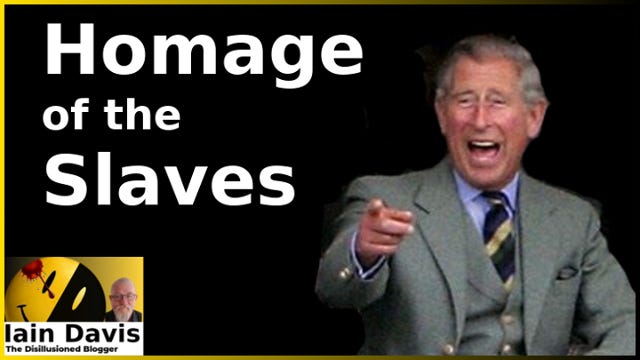
As the coronation of Charlie-boy approaches, the Royal household thought it would be nice to offer the British public the opportunity to swear their allegiance to King Charles III and declare themselves his slave. This “homage of the people” has been very popular amongst some. Presumably, they’re dead keen to live a life of slavery.
Apparently, Shabana Mahmood, the Labour Party’s national campaign coordinator, thinks slavery is a “lovely idea” and that involving the people in the coronation, by offering them to opportunity to become slaves, was a “lovely touch.” The UK transport secretary, Mark Harper, thinks that elective slavery represents a “fantastic opportunity.” Although, he didn’t specify for whom.
Iain Davis Substack is a reader-supported publication. To receive new posts and support my work, consider becoming a free or paid subscriber.Subscribe
Harper went on to suggest that enslaving millions of people will provide a “great showcase for Britain around the world.” This doesn’t appear to be necessary. Given its colonial past and current foreign policy, it seems likely that most people are already familiar with the way the British state rolls.
Perhaps unsurprisingly, the “homage of the people” has not been pitched by the Establishment as the “homage of the slaves”. It’s an invitation, not a command, and everyone knows that merely attempting to enslave people is a kind of altruism.
Like Shabana and Mark, Vince, the Archbishop of Westminster, described this invitation as “remarkable” and “lovely,” with Sky News reporting:
For the first time in history the public will be given an active role in the coronation, having been invited to say the oath to the King out loud.
Of course, the whole point of his oath is that he, as the head of state, swears his allegiance to us. But let’s not allow our codified constitution to get in the way of a good old, statist hallucination. We haven’t for more than 800 years, so why start now?
That being said, it is not without good reason that an apparent majority of people have decided that they do not want to pay “homage” to an inept toff. This seems reasonable, because it avoids making the bat-shit crazy decision to pledge your “obligation of fidelity and obedience” to some bloke wearing a load of moody gold.
For those who fancy the idea of enslaving themselves to a clueless aristocrat, before you guffaw in scornful rejection of any suggestion that you are, in fact, choosing to be a slave, it is perhaps worth noting what an oath of allegiance actually means:
[. . .] the obligation of fidelity and obedience which the individual owes to the government under which he lives, or to his sovereign in return for the protection he receives
Your “allegiance” means you pledge your “obedience” in return for protection. This is commonly known as a “protection racket.”
It get’s worse:
The citizen or subject owes an absolute and permanent allegiance to his government or sovereign, or at least until, by some open and distinct act, he renounces it and becomes a citizen or subject of another government or another sovereign.
You may have noticed your somewhat limited choices if you are ever dumb enough to swear an oath of allegiance to the parasite class. You can’t really get out of it unless you subsequently swear your “absolute and permanent” “fidelity and obedience” to the next parasitic scumbag that elbows their way in to your life.
Still, each to their own. Who am I to put anyone off opting to be a slave?
Nonetheless, before you do, perhaps spare a moment to consider your choices. There are better slave masters laying about, should you want one.
Perhaps you could choose to be Elon Musk’s slave instead? As these things go, choosing Charles as your personal oppressor might be a bit iffy.
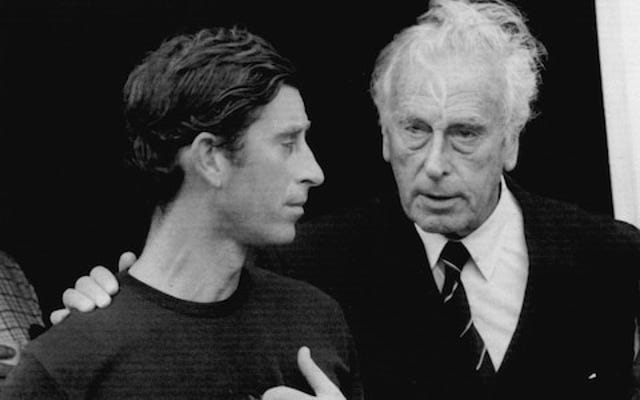
[then] Prince Charles and Uncle Dickie Mountbatten
Charles was mentored by his father’s uncle, Lord Louis Mountbatten (Prince Louis of Battenberg), who he affectionately called “Uncle Dickie.” A frequent visitor to his “honorary grandpapa’s” Broadlands estate, the young Charles often holidayed with the Mountbattens.
As an adult, Charles was encouraged by “Uncle Dickie” to use Broadlands for any sexual rendezvous that Charles would rather keep quiet. The US Federal Bureau of Investigation (FBI) described Mountbatten as a paedophile “with a perversion for young boys.”
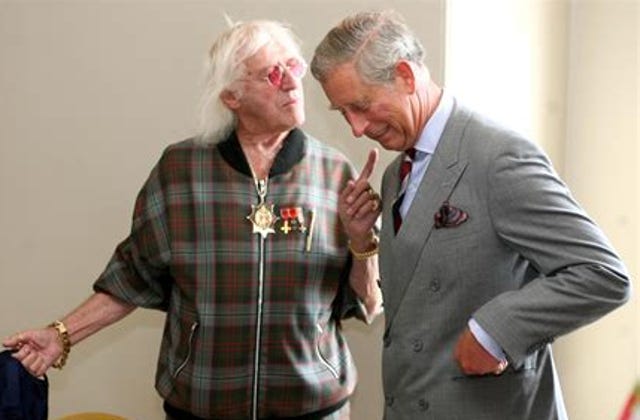
Child rapist Savile and King Charles – an interesting power dynamic.
When the Bishop and notorious paedophile, Peter Ball, first accepted a caution—prior to his subsequent conviction in 2015—Charles felt that a “monstrous wrong” had been inflicted upon the pederast. Knowing the nature of the allegations, and Ball’s admission of guilt, Charles purchased a property for Ball and his twin brother.
King Charles subsequently denied all knowledge of Ball’s vile crimes in the letter he submitted to the Independent Inquiry into Child Sexual Abuse. The explanation he offered was idiotic:
I was certainly not aware at the time of the significance or impact of the caution that Peter Ball has accepted, or indeed sure if I was even told about it. Whilst I note that Peter Ball mentioned the word in a letter to me in October 2009, I was not aware until recently that a caution in fact carries an acceptance of guilt.
This is in keeping with the story we are given about Charles which suggests he is a gullible pillock. Presumably, this naive stupidity extends to the enormous advisory team that surrounds Charles and the Royals.
It seems, no one advised Charles to stop hanging around with nonces. Although, admittedly, in his family, it is hard to avoid them.
Not a single one of his vast array of advisers took the time to explain to Charles what the legal implications of a caution were. Furthermore, all of them were completely unaware that their future, simple-minded King was “accidentally” maintaining a series of close friendships and “special” relationships with child rapists.
Despite all of this, some people really love waving their little flags and remain eager to declare their oath of obedience to this man. Perhaps because they have have no idea what it means or perhaps because they are as thick as he is.
It is good to know that becoming Charles’ slave is not a direct command. Many people would prefer to completely ignore the World Economic Forum (WEF) spokesman and hypocrite, King Charles III. We certainly wouldn’t want to spoil his day by telling him to shove his “invitation” where the sun doesn’t shine.
Iain Davis Substack is a reader-supported publication. To receive new posts and support my work, consider becoming a free or paid subscriber.
Subscribe
William PrittingWrites William’s Substack17 hr ago Liked by Iain DavisKing Charles and the Globalists set meeting for September at which they will plot how to accelerate goals of U.N. Agenda 2030 and the complete digitization of humanity Last week the WEF released a post saying that “civic participation is key to meeting UN sustainability targets” to fulfill the goals of “Agenda 2030.”
The WEF wrote:“Attacks on civil society and civic freedoms threaten to unravel achievements in meeting the UN Sustainable Development Goals (SDGs). They are weakening action to tackle economic inequality, gender imbalances, corruption and environmental degradation.” So they have planned a special 2023 SDG Summit for September 18-19 in New York, where they will discuss the world’s shortcomings in meeting their 17 Sustainable Development Goals, calling the forum meeting “enormously significant,” as a select group of world leaders are expected to be in attendance. According to the U.N. website:“They will carry out a comprehensive review of the state of the SDGs, respond to the impact of multiple and interlocking crises facing the world, and provide high-level political guidance on transformative and accelerated actions leading up to the target year of 2030 for achieving the SDGs. ”The U.N. posting goes on to say that: “The special edition of the report of the Secretary-General entitled ‘Progress towards the Sustainable Development Goals: Towards a Rescue Plan for People and Planet’, the Advance Unedited version has been released.”
Humans may be biologically wired to go with the flow and stick with the majority group, even if they don’t agree with its intentions
In the 1950s, psychologist Solomon Asch conducted a now-classic social psychology experiment showing the power of peer pressure and the desire to fit in
Governments, corporate giants and globalists are able to shape public opinion and behavior of the masses by “manufacturing illusions of consensus”
False beliefs about public majority opinions may drive people to censor their true opinions about an issue, furthering an altered perception of reality and conformity
Even minor displays of noncompliance can give others the courage to follow, triggering a ripple effect that can change society
Plans for a totalitarian future are dependent on obedience of the masses. Without compliance, criminal authoritarians cannot succeed in their plans to gain control over society and humanity. Given the choice, it seems clear that most people would choose freedom and autonomy. Yet, history shows a different reality, one in which an evil few succeeded in laying down a nefarious path and gaining supporters to walk down it.
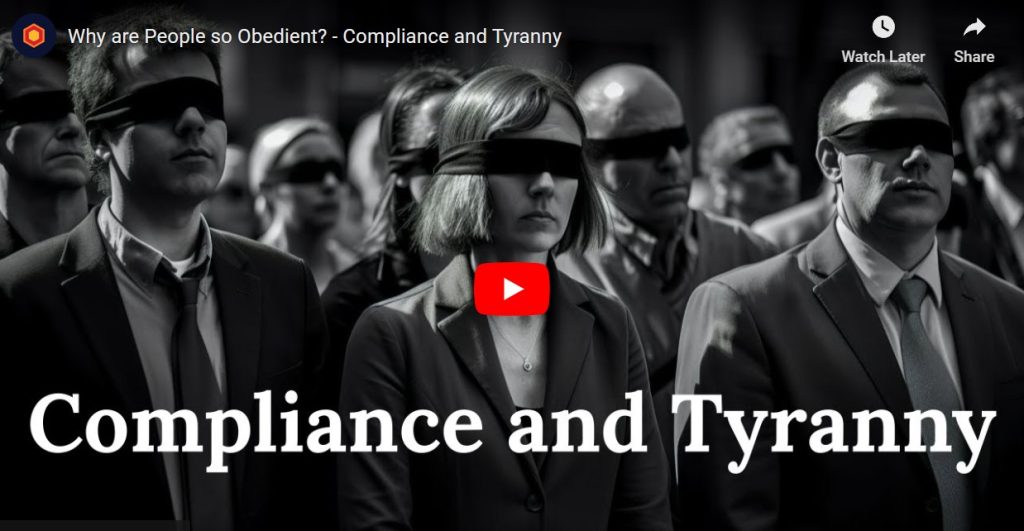
So, why are people so obedient, even when following along parts ways with their morals and belief systems? Academy of Ideas, which aims to promote freedom by creating videos highlighting some of the world’s greatest thinkers, spells it out in the video above.1
In short, humans may be biologically wired to go with the flow and stick with the majority group, even if they don’t agree with its intentions. But there are ways that you can consciously opt out.
Asch Conformity Experiments Show Power of Peer Pressure
In the 1950s, psychologist Solomon Asch conducted a now-classic social psychology experiment on a group of college students.2 They were shown a card with a line on it, then shown a second card with multiple lines and asked to choose which line was the same length as that on the first card. Only one answer was clearly correct.
The students were placed into groups with actors who, on the third trial, all gave the same wrong answer to the test. In this case, the students tended to follow along with the group, even though their responses were obviously incorrect.3 According to Academy of Ideas:4
“Rather than state the obvious truth, the test subjects gave the same wrong answer as the group 37% of the time, and of the 123 test subjects who took part in this experiment, two-thirds went along with the group at least once.
Asch’s experiment confirms what philosophers have been reiterating for thousands of years: for most human beings conforming to what others say and do — no matter how objectively false or absurd — takes precedence over adapting to reality and discovering the truth.”
The video then quotes psychologist Todd Rose, prior faculty member at Harvard University and author of the book, “Collective Illusions,” which suggests, “The desire to fit in is one of the most powerful, least understood forces in a society.”5 He posits that humans’ desire to belong and connect socially is so strong that it drives our behaviors, even when they’re against our own best interests.
“Most of us would rather be fully in sync with the social norms of our respective groups than true to who we are,” according to Collective Illusions.6 Further, he says:7
“… We care about being in the numerical majority even when we don’t necessarily care about the group and even when the group opinion is merely an illusion. Acting on instinct, in social situations our brains don’t actually bother to make the distinction between appearance and reality …
Even in the absence of intentional pressure or incentives, we like to go along with what we think is the consensus because, quite simply, we’re biologically wired to do so.”
Milgram Experiment Showed the Power of an Order
The tendency to obey at any cost, even in the absence of an incentive to do so, was also illustrated in The Milgram experiment, which was conducted following the trial of Nazi Adolf Eichmann, who used the Nuremberg defense, or “befehl ist befehl,” which translates to “an order is an order.”
The Milgram experiment showed that people would act against their own judgment and harm another person to extreme lengths simply because they were told to do so.
The subjects first experienced a 45-volt shock themselves — so they would know what it felt like — then administered the shocks in increasing intervals. They were labeled from 15 to 450 volts — from slight shock all the way up to “extreme intensity shock,” “danger: severe shock,” and the strongest voltage, “XXX.” According to Gregorio Billikopf Encina with the University of California:8
“In response to the supposed jolts, the ‘learner’ (actor) would begin to grunt at 75 volts; complain at 120 volts; ask to be released at 150 volts; plead with increasing vigor, next; and let out agonized screams at 285 volts.
Eventually, in desperation, the learner was to yell loudly and complain of heart pain. At some point the actor would refuse to answer any more questions. Finally, at 330 volts the actor would be totally silent-that is, if any of the teacher participants got so far without rebelling first.”
Ultimately, 65% of the subjects continued through the study and administered the maximum voltage level, even though they knew it was wrong.
Governments, corporate giants and globalists are able to shape public opinion and behavior of the masses by “manufacturing illusions of consensus.” It’s psychological warfare, the type of which we saw play out in force during the COVID-19 pandemic.
Accusations of being “grandma killers” or “anti-vaxxers” toward people who chose not to get a COVID-19 jab or wear a mask are examples of the powerful rhetoric used to keep people complacent. According to the video:9
“They harness the power of the mainstream media and social media for the express purpose of making it seem as if the majority supports certain agendas, ideologies, and mandates. Slanted narratives, biased reports, rhetoric that appeals to emotion, misleading ‘fact checks,’ outright lies, dubious opinion polls, and social bots are some of the weapons used in this subtle form of psychological warfare.”
Rose is cofounder and president of Populace, a think tank investigating the widespread misconceptions people have about political and social consensus. “Name anything that truly matters to you, and I’ll wager that you are flat-out wrong about what the majority of people really think about at least half of them. And that’s being generous,” Rose says.10
These false beliefs aren’t innocuous, however, as they may drive people to censor their true opinions about an issue, furthering an altered perception of reality and conformity. According to Rose:11
“Collective illusions are social lies. They occur in situations where a majority of individuals in a group privately reject a particular opinion, but they go along with it because they (incorrectly) assume that most other people accept it. The result is a pernicious, self-fulfilling prophecy.
By making blind and ultimately false assumptions about the opinions of those around us and worrying that we are in the minority, we become more likely to perpetuate the very views we and others do not hold. Worse, because the very same people who disagree with the status quo are the ones enforcing it, it becomes all but impossible to dismantle the illusion.”
Parallel Reality: Humans Are Both Victims and Supporters
It was 1978 when Václav Havel, former president of Czechoslovakia, wrote, “The Power of the Powerless.” It describes the manager of a grocery store, greengrocer, who puts up a sign in his shop window that states, “Workers of the world, unite!” It’s a government-endorsed slogan in support of the communist regime, and it’s one that’s seen around the city.
Greengrocer hung up the sign not because he believed in its message or the government behind it, but because it was an expectation and something that everybody else was doing, too. The video explains:12
“The greengrocer did not believe in the message of the sign — to him it was nothing more than cliche propaganda. After decades of harsh political oppression, it was clear to him that the government’s alleged concern for the workers of the world was an ideological front to conceal their thirst for power.
Yet even though the greengrocer knew that the sign was propaganda, each morning he hung the sign anyways, because that’s what everyone else did. Government-endorsed signs hung in the window of every shop; they formed a part of what Vaclav Havel called ‘the panorama of everyday life,’ which helped to create, and sustain, the collective illusion that the majority supported the government.”
In this totalitarian system, Havel explains, citizens become both victims and supporters of the machine. Only by individuals breaking free of the cycle and speaking up for their true beliefs can the system be broken and, ultimately, fail.
One day, greengrocer decides he doesn’t want to display the slogan in his shop’s window, then stops sharing other government propaganda and starts to publicly express his opinions. His actions have a ripple effect around him. Rose writes:13
“… Surprisingly, with amazing speed, the greengrocer began to gain support for the simple reason that everyone else in the city felt exactly the same way he did. Tired of living under oppression, the tailor and the baker and the office worker followed his lead. The moment the greengrocer stopped cooperating, he sent a signal to everyone else that they could do likewise.”
One by one, noncollective actions weaken the authoritarian rule, ultimately gaining enough strength to bring it down. As Havel explained:14
“By breaking the rules of the game [of tyranny], the greengrocer disrupted the game … He exposed it as a mere game … He said that the emperor is naked. And because the emperor is in fact naked, something extremely dangerous happened: by his action, the greengrocer … enabled everyone to peer behind the curtain. He showed everyone that it is possible to live within the truth.”
A Butterfly Effect to Change Society
It’s essential that your Constitutional rights and civil liberties be safeguarded against unlawful government overreach. Yet many are willingly giving up freedoms that, once gone, may be difficult, if not impossible, to get back. One way to stop this from happening is to stand up for your beliefs, using civil disobedience to protect your freedom. According to the film:15
“As highly social beings, what we say and do influences the people we encounter, and even minor displays of noncompliance and nonconformity have the power to ripple outward and initiate a butterfly effect that changes society in dramatic ways.
Hence why [Soviet dissident] Aleksandr Solzhenitsyn stated that a single individual speaking the truth could bring down a tyranny, or as Henry Melvill observed, ‘Our lives are connected by a thousand invisible threads, and along these sympathetic fibers, our actions run as causes and return to us as results.’”
If the costs of speaking out or going against the grain are too severe due to the economic, social or physical repercussions that could result, Rose suggests sowing seeds of doubt, which can be enough to get the snowball rolling:16
“For example, you can say something like, ‘I haven’t made up my mind yet’ or ‘On the one hand, I can see the value of x, but on the other …’ You can also suggest other options by saying things like ‘I have a friend who …’ or ‘I read somewhere that …’
Doing this gives you plausible deniability while retaining your sense of control. It also offers an escape hatch for others who have been afraid to speak up. Often all it takes is a single spark of ambivalence or mixed opinion. Once you crack open the door, others can gain the courage to follow.”