Please click on the link for the original: https://www.youtube.com/watch?v=yZm_6Q4bqxE
The Shocking 1357 Manuscript and that Reveals Tartaria’s Buried History
What if an entire empire could be erased from history so completely that only a single manuscript from the year 1357 still remembers it?
And what if that manuscript was never meant to survive?
We begin not with a monument, a ruin, or even a fragment of stone, but with a book. A book that should not exist. A book that should not say what it says.
and a book that casts a shadow across everything we think we know about the medieval world.
Its pages are thin, yellowed, fragile enough to crumble between careless fingers. Yet what they contain is heavier than any empire, more enduring than any chronicle approved by kings or councils.
This manuscript known as The Travels of Sir John Mandeville was supposedly written by a wandering knight, a man who claimed to have crossed nearly all the lands known and unknown to the medieval mind.
Most historians dismiss it as a curiosity, a medieval oddity suited for libraries but not for classrooms.
But
the manuscript is older than most of the histories that contradict it. It predates the so-called official cograph of Eurasia.
And within its cramped handwriting lies a world our modern maps no longer recognize. The text does not sound like myth. It does not meander like a fable.
Instead, it catalogs the earth with the precision of a census and the confidence of a royal report. Distances are measured in days. Mountain ranges are described as though their outlines were sketched directly onto the page. Sir
John writes of kingdoms whose names have long vanished, of rulers whose power should have towered over Europe like a storm cloud, and of a world that feels less like a fantasy and more like a memory someone tried very hard to forget.
And it is here in these contradictions that the first tremor of suspicion begins. If the manuscript were pure fiction, why does it read like a survey? Why does it speak in a voice that sounds like an eyewitness rather than a storyteller?
The deeper we peer into these pages, the clearer it becomes that this book is not describing an imaginary world.
It is describing a deleted one. The medieval era we are taught in school is one of scarcity, fragmentation, and smallness.
Isolated kingdoms, slow trade routes, little knowledge of distant lands. Yet Mandeville’s world is wide, interconnected, alive with color and danger. He writes of a spring near Mount Palumbo, whose waters are fragrant, shifting their taste every hour like a living organism, exhaling spices into the air.
He describes it not as a legend but as a fixed point on the earth, a known landmark for travelers, a place of healing where three sips could cure any illness.
In the official history of Europe, healing springs belong to mythology.
But in his world, they are simply geography. And then there are the creatures. Creatures we relegate to heraldry and story books. Yet he describes them with anatomical detail as though he had seen them bleed.
Griffins stronger than eight lions. Eagles large enough to lift a horse in their talons.
Bones used by archers to craft deadly bows prized for their power. None of this is presented with metaphor or symbolism.
The tone is matter of fact, the way a merchant might describe goods or a soldier recount an enemy.
Even the strange branches of humanity he encounters, horned men in the desert, giants 30 to 50 feet tall, roaming remote islands dragging ships from the sea, are spoken of without fear or doubt. They are simply inhabitants of a world we no longer see.
But it is not the giants nor the griffins that challenge our understanding the most. It is the nations, entire peoples missing from every map we have now today.
According to the manuscript, near the Caspian Mountains lies a region known as the mountains of Uber, a harsh land where 10 tribes known to the world through the
ominous names Gog and Magog were imprisoned, not metaphorically, physically, enclosed behind mountains that sealed themselves like the closing of a divine gate.
Mandville claims this was done during the campaigns of Alexander the Great, who overwhelmed by their number called upon heaven itself to close the earth around them.
And in the manuscript, this imprisonment is not history. It is present tense.
In the year 1357, the tribes of Gog and Magog still lived behind those mountains, still isolated, still sealed away from the world.
There is no hint of myth in his description. He gives the name of the pass, Claren. He gives the name of the guardian, the queen of the Amazon.
He asserts that sometimes individuals escape, wandering into foreign lands, unable to speak anything but ancient Hebrew.
Whether or not one believes the details, the consistency, the geographical specificity, and the intent of the narration, cannot be ignored.
Someone, either Sir John or the original chronicler he borrowed from, believed this was real geography, not religious allegory.
And then the manuscript shifts.
It moves from the fringe of the world into its heart toward the great land of Cath, a land so vast and so wealthy that its borders shimmer with caravans and merchant fleets.
Its markets overflow with silk and spices, and its capital glitters with gold floors, colossal palaces, and a ruler whose authority eclipses every monarch in medieval Europe.
According to Mandeville, he served this ruler, not for a day, not for a diplomatic visit, but for 15 months. He fought in the great Khan’s army, obeyed his commands, touched the very world he describes.
This transforms the manuscript from hearsay into testimony. Yet here is the most unsettling part. None of it appears in our history books. Not the Golden Palace, not the leather-based monetary system, not the empire whose power surpassed all European kingdoms combined, not even the proper name of the land itself.
Because the manuscript does not identify this realm as China.
It states plainly, insistently, repeatedly that Cath and China are two different places. Cath lies beside
China. Cath is the jewel. China is its neighbor. And Cath, according to the text, is not the name of a kingdom at all. It is the central province, the beating heart of a far greater entity.
The Ancient maps and then over time shrank, fragmented, blurred, and finally vanished. A name that modern history treats like a myth. Even though the medieval world treated it like a fact, which leaves us with the question the manuscript forces upon us like a blade.
If this empire truly existed, so wealthy, so vast, so powerful that European rulers feared it, how did it disappear so completely?
How did its cities vanish without ruins? How did its chronicles burn without ash? How did its name evaporate from the collective memory of humanity? And more importantly, who made that happen? The answer begins with the first torn page of this manuscript.
Because if a civilization can be erased, then the book we hold is not merely a survival.
It is a leak. And leaks only happen when something is being hidden. To understand the weight of what the 1357 manuscript implies, we must first anchor ourselves [snorts] in the version of history we have been taught.
A version presented to us as fixed, authoritative, unquestionable.
In the official narrative, the 14th century is a world defined by fragmentation. Europe is recovering from plague and famine.
Asia is portrayed through the narrow lens of the Yuan and early Ming dynasties.
Global connections exist, but are sparse, fragile, limited to thin trade routes stitched together by rumor and dangerous travel.
Empires rise and fall in the span of centuries, but none, at least according to our textbooks, possess the scale or coherence to challenge the world order as a whole.
Yet what emerges from Mandeville’s manuscript is a world operating on entirely different principles.
A world not of small kingdoms isolated by mountains and seas, but of vast networks, bustling markets, colossal capitals, and rulers whose influence spans distances that would take months to cross.
It describes a planet more interconnected, more populated, and more politically complex than what medieval Europe is ever credited for.
We’re told that Europe at the time was a continent of modest reach, struggling with internal conflicts while barely maintaining its knowledge of lands beyond its borders.
But the chronicle suggests the opposite.
That medieval travelers moved across continents with an ease we do not associate with their era. That trade routes were vibrant threads connecting east and west. That entire civilizations thrived at scales we no longer acknowledge.
The contradiction is immediate and immense. If the world was so expansive and interconnected, where did all that complexity go? Why do our modern maps show only fragments where the manuscript shows entire nations?
The timeline reinforces this tension. The year 1357 is not some mythical date. It is a definable moment in the middle of the cathedrals, the Black Death, the Hundred Years War. and the rising power of European monarchies.
Yet, Mandaville describes a geopolitical landscape where Europe is not the center, not the peak, not even a major contender in global influence.
Instead, power lies elsewhere, concentrated in a northern empire whose presence dwarfs
even the imagination of the chroniclers we trust. If this empire truly existed in 1357,
then the silence of modern history becomes deafening.
To deepen our understanding of just how radical this contrast is, we must examine the world as conventional historians frame it. In official history, Alexander the Great’s campaigns two millennia earlier were a clash between henistic ambition and the vastness of Asia. The notion that he sealed away entire peoples behind mountains is dismissed as myth, a colorful embellishment that later storytellers appended to his biography.
Yet the manuscript insists on this as fact, embedding it into real geography, assigning it coordinates and topography.
It is not a symbolic boundary. It is a prison, an engineered isolation, and one that persisted well into the medieval period. Why would a medieval author treat mythology as geography with such confidence, unless it was based on sources we no longer possess? But the dissonance extends further. The manuscript’s portrayal of Cath, later revealed to be the jewel of great Tartaric, forces us to reconsider the entire structure of Eurasian political power. In our textbooks, China occupies the role of the ancient eastern superpower, occasionally rising to
global prominence, but mostly isolated behind mountains, deserts, and dynastic cycles. The manuscript, however, presents a neighboring nation, Cath, whose influence exceeds even that of China. This land is not an obscure province. It is the central hub of world trade, a beacon for merchants, a treasury overflowing with gold, silk, and resources that Europe could not even dream of.
And yet, curiously, the name Cath does not survive in modern geography, except as a vague echo in old maps. Why would the name of the wealthiest region in medieval chronicles disappear unless it
was deliberately overwritten? This brings us to one of the most striking peculiarities of medieval mapmaking.
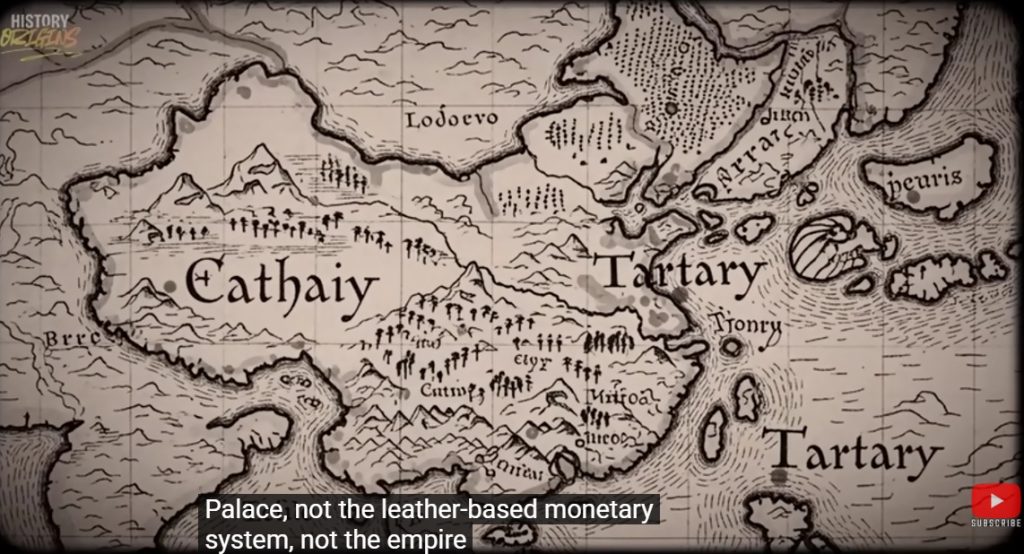
Early world maps, those created before the cardographic reforms of the early modern era, depict enormous regions labeled as Tartaria, stretching across the northern half of Asia, like an unbroken continent-sized state.
These maps were created by scholars, monks, explorers, and cgraphers who believed themselves to be drawing accurate representations of the world.
They had no reason to fabricate a mega empire spanning thousands of miles.
Yet, almost as abruptly as it appeared, Tartaria begins to shrink on later maps.
Its borders retreating, fragmenting, dissolving until by the 19th century, the name is effectively gone.
If this were merely a cartographic mistake, there would be records explaining the correction. There would be scholarly debates, documented revisions, arguments over boundaries.
But instead, there is silence, an absence so complete that it is more suspicious than any falsified map could ever be.
Historical amnesia is rarely accidental. It is curated. The manuscript’s economic details deepen this mystery. A monetary system based not on gold or silver, but on treated leather is unheard of in European economic history.
And yet, Mandeville describes it casually, as though it were common knowledge in the lands he visited.
Gold is not currency there. It is decoration, architecture, the substance of columns and walls. Nothing in medieval Europe resembles this system. There is no nation whose economy fits this profile, no empire whose wealth is described in these terms.
And yet Mandeville’s tone leaves no room for exaggeration.
He does not write like a fantasist admiring exotic wealth. He writes like a soldier describing the treasury of the ruler he served. Before we dismiss him, we must remember that this text predates the age of fantasy writing.
Medieval chroniclers did not invent entire economies or geographies for entertainment. They recorded what they believed to be true. And when they lied, they lied for theological or political reasons, not for myth making.
The manuscript’s internal consistency, the accuracy of its distances, the coherence of its descriptions, the
smoothness with which its accounts blend into known geography, suggest not invention, but memory, which leaves us with the uncomfortable possibility that the official version of history is not the original version.
that somewhere between 1357 and today, the structure of the medieval world was rewritten. That
empires were minimized, renamed, shifted, or erased.
That the world described in the manuscript was real enough to require eraser, powerful enough to threaten the narrative that later rulers wanted humanity to inherit. And this is where the contradictions begin to fold onto themselves. Why would an empire like Tartaria vanish? Why would its capital be renamed? Why would its chronicles disappear? Why would its existence be stripped from maps, from textbooks, from the collective memory of the world?
The simplest explanation, though the most unsettling, is that this eraser was intentional. that the victors of some longforgotten conflict rewrote the story of the world. Not gradually, not accidentally, but with precision, with purpose, with motive.
Before we can follow the manuscript deeper, before we can confront the evidence it presents, we must accept one truth. If this world never existed, then our history is not merely incomplete. It has been edited, and the edits were not made for our benefit.
If the background of the 1357 manuscript already strains the limits of what we consider possible, the anomalies within it break those limits completely.
They do not merely challenge our historical narrative. They unravel it thread by thread, leaving behind a
frayed tapestry whose original image is no longer visible.
And yet every anomaly presents itself not as speculation, not as folklore, but as a detail placed deliberately, confidently, as though the author assumed his readers already knew these things to be true. The first anomaly appears almost innocently, a spring at the foot of Mount Palumbbe.
Not a mythical spring, not an allegory of purity or divine grace, but a literal well of water whose scent shifts hour by hour. In one moment it smells of cinnamon, in another of cloves, in another of roses or mint, changing as regularly as the movement of a clock.
Sir John describes it with the same tone a traveler might use for a bridge or a market. And then he offers the detail that no medieval writer would casually invent. Three sips cure all illness. The chronicler does not apologize for this claim. He does not frame it in metaphor.
He simply records it as if his role is not to interpret but to witness.
This is our first loose thread. But the second anomaly pulls harder. In the lands he calls rich with strange fauna.
Mandville writes of griffins not as mythical beasts used for heraldic symbols, but as animals observed directly, hunted, feared, and exploited.
A griffin, he says, has the strength of eight lions and 100 eagles. It can lift
people fashion drinking cups from them, and its bones are used to craft bows of incomparable power.
This is not literature. It is logistics.
What kind of world allows for predators of that size? What biological reality could sustain such creatures?
And if so many cultures across Eurasia depict griffins with uncanny consistency, are they all repeating the same myth or recording the memory of the same animal?
The third anomaly concerns humanity itself. In one desert, the manuscript encounters men with horns, unable to speak, communicating only in sounds resembling the grunting of pigs. He writes of them without fear, without ridicule, as if they are simply another branch on the human tree, one his world
has not yet severed from our own. It raises an unsettling question. If humanity once existed in more varied forms, how many branches have been cut away, pruned from our evolutionary memory?
What peoples have vanished without leaving descendants?
And why do medieval texts record forms of mankind that modern anthropology insists never existed? But none of this compares to the fourth and most dramatic anomaly, the giants.
30 feet tall on the coastlands, 45 to 50 feet tall inland, capable of waiting into the sea to seize ships, dragging them onto shore as though they were toys.
Sailors feared them. Islands were avoided because of them. Legends of titanic beings appear in nearly every ancient culture, from the Nephilim of Hebrew tradition to the Yutnar of Norse myth. And yet here they are spoken of not with reverence but caution as a danger to navigation.
Mandville distances himself from the largest giants, stating that he avoided the inner regions because none who went there ever returned.
The clarity and restraint in his language, the unwillingness to embellish what he did not see strangely strengthens his credibility.
If he were fabricating, why not claim to have seen the tallest giants himself?
Why admit lack of firsthand experience unless he feared confusing rumor with testimony? And then comes the anomaly that should have shattered the illusion of our accepted history forever.
The imprisonment of entire nations behind the mountains of Uber.
10 tribes, 22 kings, sealed away by an act that the chronicler attributes simultaneously to human strategy and divine intervention.
Gog and Magog are not metaphors here, not signs of apocalyptic literature or religious symbolism. They are nations, communities, lineages placed behind a barrier that exists in geographical terms. They speak ancient Hebrew because no one has taught them anything else.
They are trapped not in time but in topography.
A single pass, Claren, remains unsealed, but even that is guarded by the queen of the Amazon.
In Mandeville’s world, the Amazon are not legends. They are a border force charged with containing one of the greatest security threats the ancient world ever faced. How could medieval Europe incorporate this into a travelog if it was pure invention?
Why reference specific mountain ranges and specific coastal boundaries? If the author was simply recycling myth. Next, we encounter Cath. So wealthy its palace floors were poured from solid gold. So lands the manuscript never even finishes describing. Yet the author does not marvel at its luxury the way a medieval European might. He records it with the flat unadorned tone of someone describing political reality. And the most jarring detail is that he served this great con personally for 15 months.
This shifts the anomaly from geographic to testimonial.
If Cath were fantasy, would the chronicler risk tying his own identity and reputation to its existence by
claiming he lived and fought within its political system? The manuscript does not allow room for allegory. It demands belief. But the most fatal anomaly to our modern narrative is the simplest one. Cath is not China.
The manuscript states this clearly.
China lies east of Cath, a neighboring country similar yet distinct. If Cath were China, how could the chronicler emphasize their difference with such precision? How could he assert that the great ruler lived not in China but in the heart of a larger empire called Tartery?
And this anomaly does not come from imagination. It comes from the maps of the era. Medieval cgraphers consistently placed Cath and China as separate entities, both surrounded by the vast northern expanse labeled Tartaria in capital letters large enough to dominate the map. Every anomaly in the manuscript pushes us toward the same conclusion that the world described within it does not fit the one we learn in school. Not because the author was fantasizing, but because the world we learn in school is incomplete.
Something is missing. Something enormous.
Something that stood too tall, too powerful, too wealthy, too different, and therefore had to be removed. Each anomaly is not an isolated contradiction. It is part of a pattern, a woven latus of details that together
history. A structure that was dismantled and buried. A structure whose ruins are now linguistic, cardographic, mythological, and scattered across manuscripts like this one.
The question is no longer whether the anomalies matter. The question is what they point to when assembled together. And the answer begins to take shape like a silhouette behind a torn curtain. The manuscript is not describing fantasy. It is describing a world that existed before someone erased it. When we step back and examine each anomaly in isolation, they appear strange, disjointed, perhaps even unbelievable.
A healing spring that changes scent and taste each hour. Griffins with the strength to lift horses into the sky.
Horned men grunting through deserts.
Sealed behind mountains by divine intervention. A golden capital serving as the beating heart of a world spanning empire. At first, these stories feel like fragments of myth scattered across a landscape too large to comprehend.
yet, but enough to reveal the outline of a forgotten world. A structure so vast and so consistent that it becomes nearly impossible to dismiss. A single detail may be strange. A dozen details may be coincidence. But a network of details intersecting across geography, culture, economics, and testimony points to something else entirely.
The first connection becomes visible when we compare the manuscript’s geography with depicted Tartaria as an enormous region stretching from the eastern edge of Europe to the shores of the Pacific. This was not an obscure region to them.
It was labeled boldly, confidently, often comprising half the known world.
Yet modern maps of the medieval era, maps created centuries after the original ones, either shrink this expanse or erase it altogether.
That is our first clue. Mandeville’s manuscript does not invent a mega empire. It reflects the cardographic
reality of its time. And if we align his descriptions with surviving maps, we begin to see the faint outline of a continental power whose influence once shaped Eurasia.
He was describing a world his readers would have recognized. The second connection appears in the manuscript’s economic details. The leather-based
currency of Cath makes no sense if Cath were an isolated kingdom. But it makes perfect sense within the infrastructure of a centralized empire controlling resources across a vast territory.
Durable, portable, and difficult to counterfeit, ideal for an empire concerned with taxation and standardization.
Meanwhile, gold is pulled from circulation and used for infrastructure, decoration, and architecture, symbolizing not scarcity, but abundance.
We see hints of this system in other ancient cultures, from the treasury driven economies of Persia to the gold laden temples of India.
But the manuscript’s version is far more extreme. gold floors, gold columns, not the behavior of a kingdom.
It is the behavior of an empire.
The third connection involves the anomalies that resemble biological impossibilities.
Griffins, horned men, giants.
Individually, these might be dismissed as exaggerations, but what stands out is not the creatures themselves.
It is the way the chronicler writes about them. There is no embellishment, no awe, no metaphor. Each creature Griffin feathers used for bows, giant threats affecting maritime travel, horned men described as a local population rather than a supernatural encounter. If these descriptions were intended as myth, the tone would carry hints of symbolism or narrative purpose.
Instead, the chronicler sounds like a man cataloging resources, dangers, and curiosities encountered on a journey.
This tone consistent throughout the manuscript makes it statistically improbable that all such accounts are inventions. A fantasist exaggerates, a traveler records.
This leads us to the fourth connection, the sealed tribes of Gog and Magog. The story appears in multiple ancient traditions from Hebrew texts to Greek chronicles to Islamic esquetology.
Yet each tradition treats it differently. Some metaphorically, some literally, some as prophecy, others as history. Mandavville’s version is the only one that combines theological significance with geographical specificity.
He names the mountains. He names the pass. He references the Caspian Sea. He even mentions linguistic isolation, describing how escapees speak only ancient Hebrew.
If he were fabricating this story for religious effect, he would have leaned more heavily on symbolism or prophecy.
Instead, he situates the event firmly in the physical world.
When multiple independent traditions record the same event and a medieval traveler anchors it on a map, the likelihood of a shared underlying event increases dramatically.
But the most revealing connection emerges when we study how the manuscript distinguishes between Cath and China. According to official history, Cath is simply an old name for China, a linguistic variation, a misinterpretation corrected by later historians.
But the manuscript contradicts this with unwavering clarity. Cath lies beside China, similar but separate. China is east of Cath. China is not the seat of the great Khan. Cath is the center of power, the jewel of the empire, the province where the golden palace stands.
And Cath according to the chronicler belongs to a larger political entity Tarter.
Cath or Katy is often placed west or northwest of China within territory marked as Tartaria.
The chronicler’s testimony aligns not with modern geography but with contemporary cgraphy. This suggests that the correction made by later historians, the conflation of Cath with China, was not a correction at all, but a substitution. The patterns are unmistakable.
When multiple anomalies converge on the same conclusion, we no longer have anomalies. We have evidence. Evidence of a world where Tartaria was not simply a geographic label, but a functioning entity.
One with a capital, a ruler, an economic system, and a political structure. Evidence of a world populated by peoples and creatures erased from our collective memory. Evidence of borders, prisons, and quarantines that no longer appear on maps. evidence of a continental power whose existence contradicts the narrative our modern history insists on.
And then we must consider the statistical improbability of eraser. Empires do not vanish without leaving ruins. Civilizations do not disappear without leaving artifacts, languages, or descendants. Yet the manuscript speaks of a realm whose traces have evaporated. How does a civilization capable of building golden palaces, commanding armies across continents, and regulating trade on a global scale vanish so completely that even its name is dismissed as myth?
The only answer that satisfies the scale of the disappearance is not natural decay, but deliberate removal. History has gaps, but this is not a gap. This is a void carved intentionally, methodically, with precision. When we assemble the anomalies, a single shape emerges. A world that once existed but was later dismantled, rewritten, and reduced to fragments, scattered across myths, manuscripts, and old maps.
The manuscript is not a relic of fantasy. It is a crack in the wall of our accepted history. A place where the
original narrative bleeds through. And with every page we connect, the silhouette behind the curtain grows sharper.
The question is no longer whether Tartaria existed. The question is who erased it and why. Before we
reach the revelation, before we confront the theory that binds all these threads together, we must step deeper into the labyrinth the manuscript opens.
Because if the world described in 1357 was real, then someone rewrote the story of human civilization, not subtly, not slowly, but completely.
But, and the deeper we follow the trail, the more apparent it becomes that the manuscript is not merely recording geography. It is recording the aftermath of a coverup so vast that its edges still ripple through our world today.
All these threads pulled carefully from the manuscript bring us to a moment we can no longer avoid. For four parts, we have examined the contradictions, the impossibilities, the fragments of a world that refuses to fit into the version of history we were taught.
We have circled the evidence, tested its weight, compared it against maps and chronicles and the logic of empire. And now, with the anomalies assembled, a single conclusion rises from the pattern like a shape emerging from fog. A conclusion so vast and so unsettling that it forces us to rethink not just a chapter of history but the entire story of civilization.
The moment has come to say it plainly.
All these clues point to one almost unbelievable conclusion. The world described in the 1357 manuscript was the world before the eraser of great Tartaria. Not a myth, not a misinterpretation, not a medieval
fantasy, a real empire, a global power, and one that was systematically removed from human memory. This is the revelation the manuscript has been leading us toward. Tartaria was not a vague region on old maps. It was not a loose collection of tribes. It was the dominant civilization of its age. A political, economic, and cultural giant whose influence extended across continents.
The land of Cath with its golden palaces and leather currency was not a distant province of China, but the heart of this empire. The great Khan, described by Mandeville, was not a literary exaggeration.
Many ways eclipsed the kingdoms of Europe. When we evaluate the anomalies in this light, they no longer feel disconnected or fantastical. They begin to make sense. The healing spring near Palumbbe becomes evidence of a world whose understanding of nature differed radically from ours. Perhaps a
remnant of medical knowledge lost in the collapse.
The griffins, horned men, and giants transform from impossible creatures into signals of biodiversity or populations that vanished during the catastrophe that ended Tartaria.
The sealed tribes of Gog and Magog become a geopolitical event, perhaps part of the conflict between Tartaria and the Western powers. The golden palaces of Cath, the vast markets, the immense wealth, they align perfectly with an imperial center whose prosperity would have threatened emerging European states. For the first time, the pieces form a coherent picture. And then comes the most shocking element, the disappearance.
How does a civilization of this scale vanish without leaving visible ruins, without leaving architecture, without leaving documents, artifacts, or even a name that survives without ridicule? The only plausible explanation is also the most disturbing. Tartaria did not collapse naturally. It was eliminated. Not conquered in the traditional sense, not slowly weakened, erased. To erase an empire, you must do more than defeat it.
You must destroy its cities, bury its archives, scatter its people, rewrite its name, and reassign its achievements to others. You must control the libraries, the scribes, the mapmakers, the schools. You must reorder the world’s memory. This is not the work of a single kingdom. It is the work of a coalition of powers acting over generations, shaping the past to control the future. The manuscript implies exactly this.
Mandeville reports that European monarchs of the 14th century viewed the great con as a direct threat.
Not just a distant neighbor, but an existential rival capable of overpowering the entire West. If such a power existed, the West would have needed a plan, a long-term strategy, a method not simply to defeat Tartaria, but to ensure the world forgot it ever existed. And here is where the theory crystallizes into a single stark hypothesis.
Tartaria was destroyed in a global conflict, an apocalyptic event, followed by an orchestrated historical reset. The hints of catastrophe appear throughout ancient traditions. Stories of great floods, firestorms, wars of the gods, mountains that trembled, cities swallowed by earth or water.
These stories are usually confined to mythology. But here in the manuscript, they appear as echoes, as though the chronicler is standing on the edge of a world that had only recently survived a cataclysm. The giants vanished. The horned men vanished. The strange creatures vanished. The golden palaces vanished. Entire nations disappeared behind mountains that closed like a prison door. The great empire that held it all together. Tartaria was wiped from the earth. The scale of disappearance is so massive that only a disaster of planetary magnitude could explain it.
Whether that disaster was natural or man-made is impossible to say. Perhaps it was triggered by warfare, weaponry, or forces we no longer understand.
Perhaps it was geological, a cascade of earthquakes and floods that obliterated cities and erased landscapes. Or perhaps it was both. A war that unleashed a catastrophe followed by a deliberate reordering of the survivors memory by the victorious powers. And when the dust settled, the victors rewrote the map.
They took the most famous name of the empire, Cath, and attached it to China.
They erased Tartaria from records, reducing it to scattered references and derogatory depictions.
They redrrew boundaries, destroyed chronicles, burned archives, and constructed a new version of history
where Europe was the inevitable center of civilization rather than the frightened periphery it had been in the manuscript. This is why Mandeville’s chronicle feels so strange. He is writing from the world before the rewriting. A world where Tartaria still existed. A world whose memory would soon be cut away like a surgeon removing diseased tissue. A world that the emerging powers could not allow to survive. At least not in the story humanity tells itself. Consider how clean the eraser was. No ruins, no preserved cities, no remembered kings, no official chronicle of conflict. It not just absence. It is precision. It is curation. The manuscript itself becomes a kind of accidental survivor. A leak from a world whose memory was meant to be sealed. Its survival is not just improbable. It is almost subversive.
A message slipped through the cracks of a global rewrite, telling us that the world we inherited is not the original draft, but a heavily edited second edition. This theory might seem radical, even impossible, until we examine the patterns of empire.
Once a civilization defeats its rival, rewriting the past becomes a political necessity.
Every empire has done this. Rome erased Carthage, not just physically, but historically.
TheQin dynasty burned books to eliminate competing narratives. Colonizers rewrote indigenous histories around the world.
But never before and never again has a rewrite been so absolute that an entire anomalies, and
political logic far more coherently than they align with the version of medieval history we accept. Once we accept that Tartaria existed, everything else becomes clear. The anomalies become evidence.
The contradictions become clues. The silence becomes meaningful.
History did not forget Tartaria. History was made to forget it. If the hypothesis that great Tartaria was erased is true, then we must address the question that naturally follows. Where is the proof? A theory of this magnitude demands more than speculation. It requires evidence, patterns, fragments, consistencies across unrelated sources, signs that a civilization of such scale once existed, and that its memory was deliberately suppressed. And strangely, once we begin to look for such evidence, we find it not in a single artifact or ruin, but in
the absence itself, in the gaps, in the distortions, in the contradictions scattered across the historical record, like fingerprints left by an invisible hand. The first piece of evidence lies in the maps. Medieval and early Renaissance cgraphers were not guessing when they drew Tartaria.
They were recording information passed down through older sources, travelers, merchant networks, and imperial archives.
Map after map created by different hands in different nations for different purposes shows Tartaria as a massive entity. Its borders might shift slightly, its subdivisions might vary, but the sheer size of the territory remains consistent. These maps do not depict Tartaria as a wilderness or an unknown land. They label it with political terminology, kingdoms, capitals, provinces.
And yet by the 19th century, the name evaporates, not gradually, not through scholarly debate. It simply disappears, replaced with new Russian dominions, Chinese territories, and ambiguous blank expanses.
Scholars do not discuss this disappearance. They simply accept it.
But acceptance is not explanation. And a vanishing of this magnitude is itself a form of evidence.
The second piece of evidence comes from the manuscript’s internal logic. Critics claim that Mandeville’s descriptions are fantastical, impossible, exaggerated.
But skeptics overlook the most important detail. The chronicler differentiates clearly between what he saw firsthand and what he heard secondhand.
When he describes something he did not personally witness, such as the largest giants, he says so. When he describes something he experienced, such as serving in the great Kh’s army for 15 months, he asserts it with matter-of-act certainty.
This distinction is crucial. It suggests he is not inventing a world of fantasy.
He is reporting it as he encountered it.
And he does so with a consistency that fabricators rarely maintain. We see similar logic in the descriptions of geography. Cath lies beside China. China lies east of Cath. The Great Khan rules from Cath, not from China. This distinction aligns with medieval maps showing Katy or Cath as separate from the Chinese dynasties. It is only modern historians who fuse the two, claiming that Cath was simply Europe’s
misunderstanding of China. But if medieval geographers knew so little, why would they consistently depict two separate regions?
Why would they place the capital of one beneath the rule of an emperor different from China’s?
Why would they assign distinct trade networks, currencies, and political structures to each?
Misunderstandings are random.
This is pattern. The third piece of evidence concerns the economic details. Leather currency is not an invention. It appears in multiple early Asian records, including Mongol administrative documents describing the use of treated hide as a standardized form of exchange.
But in Europe, where gold and silver reigned supreme, the concept would have seemed alien, unless Mandeville truly encountered it. The description of gold used as architectural material rather than money fits with accounts of eastern palaces written by other travelers as well. Marco Polo, for example, wrote extensively of gold covered halls and structures without treating them as fantasy.
The alignment between testimonies separated by time and region strengthens the credibility of the manuscript.
When two independent chronicers describe the same economic and architectural conditions, the likelihood of invention diminishes sharply. Next, we must consider the evidence hidden in the anomalies themselves.
Giants, griffins, horned peoples. These sound like fantasy creatures, yet depictions of them appear across cultures far removed from each other.
Ancient Greek art, Persian carvings, Indian epics, Norse mythology, Native American stories, all reference enormous beings, eagle lion hybrids, or humanoid figures with unusual anatomical traits.
Archaeological discoveries of oversized bones, often dismissed as mammoth remains, have been quietly shelved or reinterpreted to fit modern evolutionary assumptions.
But what if these bones were exactly what earlier cultures said they were?
What if the world Mandaville describes was not biologically impossible, but simply unfamiliar to us?
A world whose ecosystem collapsed during the catastrophe that ended Tartaria. And here we reach the heart of the hypothesis, the catastrophe itself.
Many ancient traditions describe global floods, firestorms, earthquakes, and sudden environmental shifts that wiped out entire populations.
These accounts are usually seen as mythic exaggerations or religious metaphors. Yet, geological records show that major cataclysms did occur.
Volcanic eruptions that changed climates, meteor impacts that reshaped landscapes, floods that carved valleys and buried cities.
If Tartaria fell during such an event, the destruction might have been so thorough that its cities were buried beneath meters of sediment. Mud fossil theorists argue that entire regions show
evidence of rapid burial, structures encased in earth, hills that resemble collapsed architecture, strata
inconsistent with slow geological processes. Whether one accepts their conclusions or not, the correlation
between sudden destruction and historical eraser is significant.
The fourth piece of evidence is more subtle, but perhaps the most compelling textual silence.
Silence is rarely organic. When civilizations collapse naturally, their neighbors record it. Their trade partners mourn or celebrate their fall.
Their rivals describe the wars, the plagues, the disasters. Yet in the case of Tartaria, there is nothing, no
chronicles of war, no records of decline, no detailed accounts of conquest. It is as if the empire simply
evaporated. This is not how history behaves. It is how censorship behaves.
The fifth piece of evidence is linguistic.
Place names connected with Tartaria linger in folklore, tribal names, and regional dialects across Central Asia, Russia, Mongolia, and China. Entire cultures retain fragments of a story they no longer fully understand. Names like Tatars, Cath, Tartery, and Cyia echo through centuries of poetry,
legend, and oral tradition. These linguistic remnants suggest not a myth but a cultural trauma, an empire
remembered only in pieces because someone severed the larger narrative.
Then we must confront the counterarguments. some historians claim Mandville copied earlier works and inserted exaggerations.
True, he borrowed from older sources, but this strengthens rather than weakens the case. If the manuscript were purely fictional, why does it preserve details consistent with older maps, older chronicles, older myths that all point to a coherent geopolitical structure?
Others argue that medieval writers often included fantastical creatures, but those same writers also recorded real geography, real politics, real observations alongside those creatures.
Medieval chronicles did not separate myth and history the way we do. They preserved the world as they understood it, not as later academics reinterpreted it. A more serious counterargument claims that Tartaria was simply an outdated term for loosely organized step tribes. But this contradicts the maps which depict not tribes but borders, capitals, provinces, networks, empires.
When dozens of maps across centuries depict a unified region with political significance, dismissing it as a
misunderstanding becomes intellectually dishonest. And finally, the strongest counterargument is the absence of ruins.
But absence is not evidence of non-existence.
Absence is often evidence of destruction. Cities built of wood could burn. Cities buried in floods could fossilize beneath layers of earth.
Catastrophes could erase stone and metal alike. And more importantly, deliberate eraser, controlled demolition, repurposed stone, rewritten history could eliminate the visible traces of an empire more efficiently than time ever could. When we weigh the evidence, a picture emerges that is difficult to ignore. the maps, the linguistics, the economic details, the cross-cultural myths, the manuscripts internal consistency, the total silence that follows, all point toward the same conclusion. Tartaria was real, and someone wanted us to forget. In the end, the most convincing evidence is not what remains, but what is missing. Not what is said, but what is not allowed to be said. Not the ruins we can touch, but the histories we are no longer permitted to read. And now, with the evidence assembled, we can finally confront the question that lingers behind every page of the manuscript.
Not just what happened to Tartaria, but why it had to disappear. If the manuscript is a window into a world erased, then part seven asks us to step back from the evidence and observe not the fragments themselves, but the shape they cast upon the wall behind us. Because a question of this magnitude, why would an empire be deliberately removed from human memory, is not simply historical, it is existential.
our entire understanding of civilization rests.
Were torn away like pages from a forbidden book? What does it say the ashes of something older, richer, more complex than we were ever permitted to imagine. For a moment, imagine history as a vast library. Each civilization a shelf, each empire a volume, each event a page within those volumes.
The story of humanity is not static. It is written and rewritten by those who hold the pen. Now imagine that long ago someone walked through this library and began removing books quietly, selectively with purpose. Some shelves were rearranged. Some volumes were replaced with new additions. Others were burned entirely.
What remains is not the true library, but a curated collection, a version of the past designed not to inform, but to control. If Tartaria was one of the missing volumes, then its absence did not occur because it lacked importance.
On the contrary, it vanished precisely because it mattered too much. When we look back at the evidence, a picture begins to form. Tartaria was not an isolated culture on the fringes of Eurasia. It was a colossal geopolitical force, a rival to rising European powers, a civilization whose scale and infrastructure threatened to overshadow the West. In the narrative we inherited, Europe becomes the natural center of progress, the inevitable engine of enlightenment.
But what if Europe was not the engine?
What if it was the beneficiary of a silence imposed after a catastrophe that destroyed its greatest rival?
If the West restructured the narrative after Tartaria’s fall, then modern history is not a story.
It is a strategy. Consider what it means for our identity. If the world we know is a reconstruction, not an evolution.
We measure ourselves against ancestors we believe we understand. We believe their limits were our limits. Their achievements define the boundaries of what humanity was able to accomplish before the advent of modern science. But the manuscript hints at something else.
A world where nature behaved differently. Where biodiversity was more dramatic. where strange branches of humanity coexisted, where technologies or understandings of the natural world may have been more advanced than what survived. If Tartaria embodied an alternate path of civilization, a path that did not lead to the world we know now, then its eraser is not simply a loss. It is a substitution,
a replacement of one possible future with another.
This raises deeper questions. Questions that stretch beyond archaeology and history and enter the realm of philosophy.
What does it mean to inherit a worldview built on absence? What does it mean to grow up in a story where the most powerful empire of the medieval world is missing? What does it mean for our sense of curiosity, our intellectual freedom, our collective imagination? If the map we were handed as children was deliberately redrawn to fit a specific narrative, when we remove a chapter from a book, the remaining chapters do not simply shrink. They shift. They contort to fill the space left behind. The entire story warps.
This is what happened to history after the disappearance of Tartaria.
The West did not simply add itself to the timeline. It rearranged the entire timeline so that it appeared inevitable, triumphant, and uncontested. But the implications run deeper still. If Tartaria was erased, it suggests the presence of a power capable of performing that eraser. a coalition with reach across continents, influence over scholars, archavists, cgraphers, religious institutions, and political systems.
Whoever rewrote the past did not simply hide a nation. They redesigned the structure of time itself, dictating what future generations would believe possible.
And when you control the past, you control identity. You control destiny.
You control the boundaries of what humanity imagines itself capable of.
This is why the manuscript feels so dangerous. Not because it contradicts history, but because it escapes the edit. It is a leak, a breach, a surviving page from a volume that was supposed to be destroyed. And what do we do when we find a page torn from a book that no longer exists?
We ask, “What was the book about? Who removed it? And what were they trying to hide?” The emotional weight of this realization is heavy. There is a sadness woven into the possibility that humanity once shared its planet with cultures, species, and knowledge systems far broader than our modern world allows.
There is grief in imagining civilizations whose voices were extinguished not by time but by intention.
And yet there’s also a kind of awe, a widening of perspective, an awakening.
Because once we acknowledge the possibility of eraser, the world becomes larger, more mysterious, more alive with hidden potential.
The gaps in our history transform from empty spaces into invitations, spaces where new questions can grow. The implication of Tartaria’s disappearance is not merely that we lost a chapter of the past. It is that we lost an alternative path for the future.
What technologies, philosophies, or sciences died with the empire? What ideas never reached us because their carriers were buried beneath mud, stone, or silence?
What world view might humanity have inherited if Tartaria’s story had remained in the library rather than
being torn from it? And then we must confront the possibility that this erasure is not unique. If one empire was removed from the record, how many more might have suffered the same fate? How many manuscripts were destroyed? How many maps corrected? How many stories dismissed as myth because they did not fit the approved narrative?
The more we explore this idea, the more fragile our understanding of history becomes. But fragility is not weakness. It is an opportunity. A reminder that what we know is not all there is. and that the future depends not on accepting the story we were given, but on daring to question it. In the end, the most profound implication of Tartaria’s eraser is not historical. It is psychological.
It forces us to confront the uncomfortable truth that the world is built on narratives chosen by those who survived, not those who were lost.
It forces us to consider that knowledge is not neutral, that memory is not automatic, that history is not a passive record but an active construction.
And it invites us quietly, persistently to open our eyes. Because once you accept that a civilization can be
erased, you can never look at the empty spaces on the map the same way again. We arrive now at the end of this journey.
Though in truth it feels less like an ending and more like the moment just before the real story begins.
Over these eight parts we have followed a single manuscript through the ruins of forgotten geography through the shadows of erased civilizations through contradictions stitched into the fabric of medieval maps and memories. We began with questions fragmented unsettling fragile. But with each page, each anomaly, each connection, those questions sharpened into a shape too coherent to ignore. What began as a medieval curiosity has unfolded into something far deeper. The possibility that the world we inherited is not the world that once existed.
A world edited, rearranged, rewritten not by time, but by design. When we hold the manuscript of 1357 in our minds, its significance becomes unmistakable. It is not a fantasy. It is not a traveler’s embellishment. It is a survivor, a relic from a version of history that no longer fits the narrative we are taught. And its contradictions are not errors. They are scars. Scars left behind when a civilization the size of an empire was removed from the record.
Great Tartaria, the vast northern empire that medieval maps depicted with pride and certainty, did not simply fade. It
was eliminated. Its borders fractured, its name reassigned, its history replaced with silence. And the
manuscript, in all its strange, impossible clarity, sits at the boundary between what was meant to be forgotten
and what survived by accident. As we reflect on everything we have uncovered, one truth rises above the rest. History is not merely a story of what happened.
It is a story of what we are allowed to remember. And when an empire as immense as Tartaria vanishes without
explanation, it forces us to confront a difficult truth. That memory can be weaponized.
that the past can be curated as carefully as a museum exhibit arranged to guide the viewer toward one
conclusion while hiding another behind a velvet curtain. The map we grew up studying was not drawn in neutral ink.
It was shaped by victors, by survivors, by those whose future depended on controlling the past. That realization
is uncomfortable. It challenges the foundation of everything we believe about the trajectory of human civilization.
But it also opens the door to something extraordinary. The freedom to question, the freedom to imagine what lies beyond
the limits imposed on us. Because if Tartaria could be erased, then eraser itself becomes a category of evidence.
And once you understand eraser, the world becomes a different place.
Suddenly, the blank spaces on the map look less like untouched wilderness and more like wounds. Suddenly, the myths of
giants, griffins, horned peoples, firestorms, and floods look less like fantasies and more like memories from
civilizations whose stories were not permitted to continue. Suddenly, medieval chronicles feel less confused
and more honest. echoes of a world whose last breath still lingers in scattered texts and suppressed testimonies.
Perhaps the greatest implication of all is this. The true history of humanity may be far older, far stranger, and far
more interconnected than we have ever been led to believe. The manuscript is not the whole truth. It is not a
complete window. It is one page of a book that was torn apart. But through that single page, we glimpse something
vast, something monumental, something that once stood at the center of the world’s political and cultural
structure. And the fact that we can glimpse it at all means the eraser was not perfect. The redaction was not absolute.
Memory fights back. Stories survive. And sometimes the truth escapes in forms no
one expects. If we are to move forward, we must carry with us the humility to admit that we may not know the full
story. That the timeline handed down to us might be only one version of events, not the definitive one. That we are
surrounded by signs of civilizations that rose, flourished, and vanished before the world reorganized itself into
the familiar pattern we now accept. We must be willing to ask the questions we were never encouraged to ask. Why do
myths across continents describe the same beings? Why do maps across eras
depict the same absent empire? Why do manuscripts from distant regions echo the same stories of catastrophe and
reset? Why do we treat these parallels as coincidence when they align like threads woven through a tapestry torn
apart? In this final moment, we return to the manuscript itself. Its pages fragile, its handwriting uneven, its
world shimmering with contradictions that refuse to align with modern expectations.
And perhaps that is precisely why it matters. It is a reminder that the past is not a straight line, but a labyrinth,
and that sometimes the most important truths are found not in the comfortable corridors of accepted history, but in
the rooms that were locked, the shelves that were emptied, the volumes that were removed. Great Tartaria may be gone, but
its ghost lingers in the silence, in the edges of maps, in the stories that refused to die. What we choose to do
with this realization is up to us. We can look away, retreat into the safety of the familiar narrative, dismiss the
contradictions, and accept the edited version of the past. Or we can listen.
We can follow the anomalies, trace the outlines of forgotten empires, and allow the possibility of a broader, richer
history to ignite something ancient within us. The instinct to seek, to question, to remember. Because in the
end, history only becomes truth when we refuse to stop asking what lies behind the curtain. And so as we close this
eight-part journey, a new question emerges. Not from the manuscript, but from the silence it exposes. What else have we lost? What else remains buried beneath centuries of curated forgetting?
The search does not end here. If anything, this is where it truly begins.
Our investigation will continue. There are more manuscripts waiting, more maps to unroll, more erased chapters to recover.
If you want to join the next journey, if you want to help uncover the hidden layers of our past, then stay with us. Subscribe, add your voice, and follow the trail wherever it leads.
Because the truth is not gone. It is only hidden. And together we can bring it back into the world