Why the Euro Was Built to Fail (And Who Knew It)
The Wealth Records
1,47K abonnees
28.335 weergaven 15 feb 2026 #Europe #Economics #Geopolitics
In 1999, Europe made the most ambitious monetary experiment in human history. Eleven nations surrendered their currencies, their monetary sovereignty, and their economic independence — believing a single currency would unite a continent and create a superpower. Politicians celebrated. Economists cheered. And a small group of experts who warned it would fail were completely ignored.
Twenty five years later, every single warning has come true.
In this economic history deep dive, we expose the four fatal design flaws built into the euro from day one — flaws that economists identified before the euro even launched, flaws that politicians deliberately ignored, and flaws that have been destroying southern European economies ever since.
This is The Wealth Records — where economic history, monetary systems, and the rise and fall of currencies collide. And nothing is ever as simple as it looks.
Subscribe for deep dives into monetary history, financial crises, economic collapse patterns, and wealth protection strategies that will change how you see money, power, and the systems controlling our world.
Related Videos:
Why Europe’s Economy is Collapsing (The 5 Financial Wounds)
Why France is Going Broke (The 4 Hidden Cracks)
The Hidden Tax That’s Been Stealing Wealth for 2,000 Years
DISCLAIMER: This content is for educational and historical analysis purposes only. It is not financial advice, investment advice, geopolitical advice, or recommendations regarding European markets, assets, or currencies. The economic analysis, monetary system assessments, historical comparisons, and future scenarios discussed are presented for educational context and informational purposes only. They should not be interpreted as recommendations for investment decisions, portfolio allocation, currency exposure, or trading strategies related to European assets, the euro, or any financial instrument. Economic forecasts and monetary system predictions are inherently uncertain. Past financial crises and currency failures do not predict future outcomes with certainty. Individual financial circumstances and risk tolerances vary significantly. Always consult with qualified financial advisors, investment professionals, economists, or licensed experts before making any decisions related to European investments, currency exposure, or economic positioning. The Wealth Records provides economic education and monetary history analysis, not personalized financial, investment, or geopolitical guidance. Views expressed represent analytical perspectives based on publicly available economic data, academic research, and historical patterns.
Transcript
Original video link. https://www.youtube.com/watch?v=sVOrt8SfiTU

In 1999, Europe made the most ambitious monetary experiment in human history.
nations with different languages, different cultures, different economies,
and different financial histories surrendered the most powerful economic
tool a nation possesses, their currency.
They gave it up voluntarily, enthusiastically, believing that a single currency would unite a continent, end centuries of rivalry, and create a economic superpower that could challenge the United States.

Politicians celebrated. Economists cheered. Citizens were told this was the future. progress, unity, prosperity.
But behind the champagne and the ceremony, a small group of economists issued a warning so precise, so detailed, and so completely ignored that it reads today like a prophecy.
They said the euro would work for the strong and destroy the weak.
That it would trap nations inside an economic straight jacket with no escape.
That when the first serious crisis arrived, the design flaws would be exposed and the human cost would be devastating.
Nobody listened. 25 years later, every single warning has come true.
And the nations that trusted the euro the most have paid the highest price.
This is the wealth records where every video will change how you see money, history, and the systems controlling your life.
Hit subscribe and turn on notifications. You’re going to want to follow where this story goes.
And this is where money, power, and history collide.
And nothing is ever as simple as it looks. Do you think the euro can survive the next major financial crisis? Drop your answer below.
We read every single comment.
To understand why the euro was built to fail, you first need to understand why it was built at all. Because the euro wasn’t primarily an economic project.
It was a political one. After two catastrophic world wars that had killed tens of millions and reduced European cities to rubble, European leaders were obsessed with one goal above all others.
Prevent another war. And they believed with genuine conviction that economic integration was the answer.
If European nations traded together, invested together, and used the same currency, the cost of conflict would become too high.

Nations that share a currency don’t go to war with each other. That was the theory. And it wasn’t entirely wrong. European integration did contribute to the longest period of peace in European history.
But somewhere along the way, the political dream overtook the economic reality. Leaders began designing the euro not around what would work economically, but around what would advance political integration.
And those are very different things. Um the result was a currency union with a fatal structural flaw baked into its foundation from day one.
A flaw that economists identified immediately. A flaw that politicians chose to ignore and a flaw that has been destroying southern European economies ever since.
Here is the flaw. In simple terms, a single currency only works if the economies using it are similar enough to function under the same monetary policy.
If Germany needs higher interest rates to cool an overheating economy and Italy
needs lower interest rates to stimulate a stagnant one, you cannot serve both
with a single rate set by a single central bank.
You have to choose. And whoever the European Central Bank chooses to serve, the other gets hurt.
This isn’t a theory. It’s basic economics. And it was understood perfectly well before the euro launched.
In 1961, the Canadian economist Robert Mundle published his theory of optimal
currency areas.
He argued that a currency union only works under specific conditions.
Labor must be able to move freely between regions. Wages must be flexible enough to adjust to shocks. And there must be a central fiscal authority that can transfer resources from strong regions to weak ones.
Europe had none of these things. Not in 1999, not today.
European workers don’t move freely between countries the way American
workers move between states.
A Greek worker who loses his job doesn’t simply relocate to Germany. Different
languages, different cultures, different legal systems, different professional
qualifications.
The barriers are enormous. European wages are not flexible. Strong labor laws across the continue absorb shocks.
And Europe has no central fiscal authority. No European Treasury that can send money from wealthy Germany to struggling Greece the way Washington sends money from wealthy Connecticut to struggling Mississippi.
Mandel’s conditions weren’t met. The economists knew it. The politicians didn’t care.
They built the euro anyway and called the warnings pessimism. The first fatal
flaw, one size fits none.

When the euro launched in 1999, it immediately created winners and losers.
And the division was almost perfectly geographic. Northern Europe, led by Germany, had everything the euro needed.
Disciplined finances, export-entoriented industries, high productivity, low inflation. Germany had spent decades building an economy optimized for exactly the kind of monetary stability the euro required.
When the ECB set interest rates for the entire Euro zone, it essentially set
them for Germany. And those rates were catastrophically wrong for southern
Europe.
In the early 2000s, interest rates across the Euro zone dropped to historically low levels.
For Germany, this was manageable. But for Spain, Greece, Portugal, and Ireland, these rates were a disaster waiting to happen.
Because suddenly countries that had historically paid high interest rates due to their weaker economies could borrow at German rates. Spanish families could get mortgages at 3% instead of 8%.
Greek governments could issue bonds at rates barely above Germany’s. Irish banks could borrow almost infinitely at near zero cost. And they did.

All of them borrowed with both hands because the money was cheap and the euro felt
like a guarantee. What followed was predictable in retrospect.
Spain built a real estate bubble that dwarfed America’s.
Ireland’s banking system ballooned to 10 times the size of its economy.
Greece borrowed to fund a government that was spending 50% more than it was collecting in taxes.
Portugal accumulated current account deficits that made its economy structurally dependent on foreign capital.
And all of them did it under the false security of the euro, believing that membership in the Euro zone meant Germany would never let them fail.
They were half right. Germany wouldn’t let them fail. But the price of survival would be something nobody had voted for.
The second fatal flaw, the devaluation trap. Before the euro, when southern European economies got into trouble, they had a tool, devaluation.
If the Italian economy was struggling, Italy could devalue the LRA. A cheaper
Lera made Italian exports more competitive.
It made Italy cheaper for tourists. It reduced the real value of Italian wages in international terms, making Italian workers more competitive.
Devaluation was painful. It reduced purchasing power. It made imports more
expensive. But it worked. It gave economies a pressure valve, a way to adjust to economic shocks without mass unemployment.
The euro removed that pressure valve entirely and replaced it with nothing.

When Greece’s economy collapsed in 2010, Greece could not devalue. It was locked into the euro.
The only way to regain competitiveness was what economists call internal devaluation, which is a polite term for crushing wages, slashing pensions,
destroying public services, and creating mass unemployment until costs fall
enough to compete again.
In practice, it meant an entire generation of Greeks saw their living standards destroyed.
Unemployment hit 27%. Youth unemployment exceeded 60%. Doctors and engineers
immigrated. Businesses closed. Suicide rates rose. And after a decade of this
punishment, Greece’s debt was actually higher than when the crisis began.
Because austerity shrank the economy faster than it reduced the debt.
The medicine was worse than the disease, and the patient had no choice but to keep
taking it because leaving the euro was considered unthinkable.
The cost of exiting, reintroducing a new currency, facing the immediate devaluation and capital flight was judged too high.
So Greece stayed and suffered and is still suffering. A country trapped in a
monetary system designed for someone else’s economy.
Unable to devalue, unable to inflate, unable to escape.
The third fatal flaw, the democratic deficit. The euro’s third fatal flaw is
perhaps the most dangerous because it isn’t just economic, it’s political.
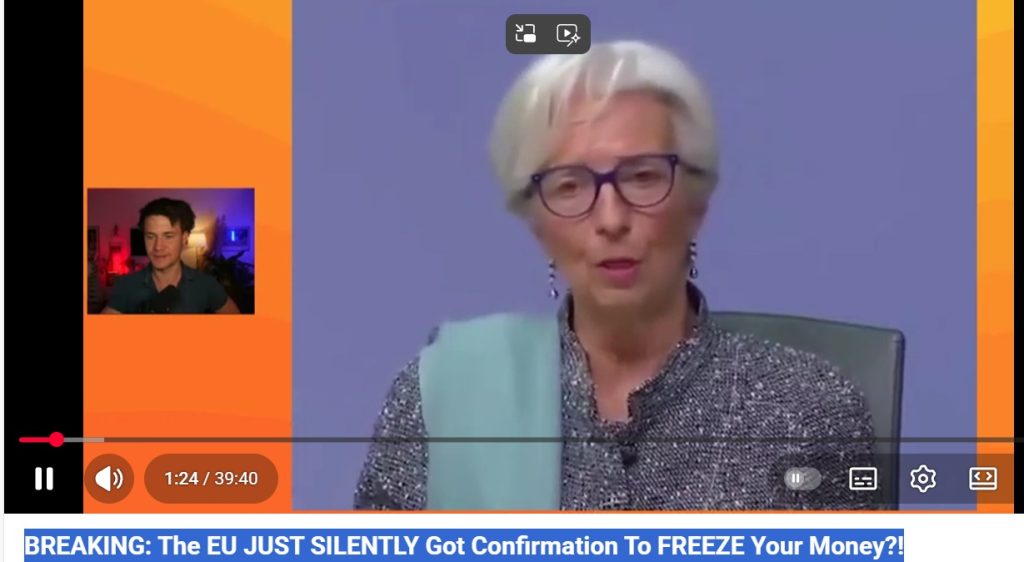
The European Central Bank is not democratically accountable to the citizens whose lives it controls.
Its governors are appointed, not elected.
Its decisions cannot be overturned by any national parliament.
Its mandate, price stability, is written into
European treaties that require unanimous agreement to change.
This means that when the ECB raises interest rates to fight inflation in Germany, crushing growth in Italy in the process, no Italian voter can do anything about it.
They cannot elect a different ECB president. They cannot vote for a different monetary policy. They are subjects of a monetary system they had no real voice in creating and have no real power to change.

This democratic deficit creates a specific kind of political toxicity.
When the ECB’s policies hurt ordinary citizens, those citizens cannot hold the ECB accountable.
So, they hold their national governments accountable instead.
They elect populist parties that promise to fight Brussels. They vote for leaders who blame the euro without being able to change it.
They oscillate between rage and helplessness.
And the political center, the parties that built and defended the euro, gets
hollowed out.
Look at Italy. For decades, Italian politics was dominated by centrist parties that broadly supported European integration.
Today, Italy is governed by parties that campaigned explicitly against the euro’s
constraints.
Look at France. Marine Le Pen, who has called for France to leave the euro, consistently polls as one of the most popular politicians in the country.
Look at Greece, the party that was elected on a platform of rejecting Eurozone austerity. Siza won a landslide election in 2015. They then spent six months fighting with European creditors before surrendering entirely because they had no real leverage.
You cannot negotiate with a currency, you cannot leave.
The democratic deficit doesn’t just create bad politics. It creates dangerous politics because when people feel they have no voice inside the system, they look for voices outside it.
And those voices are rarely moderate.
The fourth fatal flaw, the bailout trap.
The euro’s fourth fatal flaw emerged fully during the 2010 Greek crisis, and it revealed something about the euro that its architects had deliberately left ambiguous.
When a Eurozone member gets into financial trouble, who pays?
The answer, it turned out, was everyone except the people who caused the problem.
When Greece’s debt became unpayable in 2010, European leaders faced a choice.
let Greece default, which would have caused enormous losses for French and German banks that had lent heavily to Greece, or bail Greece out using European taxpayer money to repay those banks.
They chose the bailout, but they disguised it. They called it a rescue package for Greece.
In reality, it was a rescue package for French and German banks delivered through Greece. The money didn’t stay in Greece. It flowed straight through to the creditors.
Greek citizens got the austerity. French and German banks got their money back and the debt remained restructured but still crushing on Greece’s shoulders.
This pattern repeated in Ireland, Portugal, and Spain. Bailouts that were really bank rescues delivered through sovereign nations.
Austerity imposed on ordinary citizens to protect the balance sheets of institutions that had made reckless bets.
The euro’s bailout mechanism privatized gains and socialized losses on a continental scale.
Banks had lent recklessly because they assumed the euro made all euro’s own debt equally safe.
When the assumption proved wrong, taxpayers across Europe paid for the bank’s mistake and the citizens of the bailed out countries paid twice.
Once through the austerity imposed as a condition of the bailout, and again through the permanent economic damage that austerity caused.
Greece’s GDP fell by 25% during the crisis, a contraction comparable to the Great Depression. And it happened not because of a natural disaster or a war, but because of monetary policy decisions made in Frankfurt and political decisions made in Brussels that Greek citizens had no meaningful vote on.
Who knew it would fail? Here’s the part the history books rarely tell.
The euro’s design flaws were not secret. They were not discovered after the fact. They were identified, documented, and published before the euro launched.
In the 1990s, a group of German economists signed what became known as the Euro Manifesto.
They warned explicitly that the Euro zone was not an optimal currency area, that launching a monetary union without fiscal union was dangerously premature, that the weaker economies would suffer catastrophically when the first serious shock arrived.
They were dismissed as pessimists, as nationalist obstructionists, as enemies of European unity.
In the United States, prominent economists, including Milton Friedman, predicted that the euro would not survive its first serious recession.
Friedman argued that without the ability to devalue, southern European nations would face unemployment.
So severe that political pressure to leave the euro would become irresistible.
He was right about the unemployment. He underestimated how much political pain those nations would absorb rather than exit.
Even inside the European Commission, internal documents acknowledge the design problems. But the political momentum was too strong.
Too many careers, too much prestige, too much political capital had been invested in the euro.

The warnings were buried. The project proceeded. And two decades later, the warnings read like historical prophecy.
The future:
So, where does the euro go from here? There are three possibilities.
Um, the first is muddling through. The ECB continues to intervene whenever a crisis threatens to break the system.
Governments make cosmetic reforms while avoiding structural ones.
Debt keeps rising. Growth stays weak.
Southern Europe stays trapped and the euro limps forward, always one crisis away from breaking, but never quite breaking.
This is what has happened for the last 15 years, and it can continue for years more.
The second possibility is genuine reform. A real fiscal union.
A European Treasury with the power to tax and spend. A transfer mechanism that moves resources from strong regions to weak ones. A genuine political union with democratic accountability. This is what the euro actually needs to work properly and it is almost certainly politically impossible because it would
require Germany to permanently subsidize southern Europe and German voters will not accept that.
The third possibility is breakup. a crisis severe enough, a political shock radical enough to force one or more countries out of the euro.
This possibility grows more likely with every year that the structural problems go undressed.
Italy’s debt keeps rising. France’s deficit keeps growing. The ECB keeps running out of tools. And somewhere out there is a shock big enough to finally break the confidence that holds the system together.
It could be Italy. It could be a global financial crisis. It could be a political earthquake that brings a genuinely euro-skeepic government to power in a major member state. Nobody knows when, but the mathematics suggest it’s coming.
The euro was designed with a flaw at its core. A flaw everyone knew about. A flaw nobody fixed. And flaws that are known but unfixed don’t disappear.
They accumulate. They compound. And eventually they break.
Here is the lesson history has been teaching for centuries. You cannot build a durable monetary system on political wishes.
You can only build it on economic reality.
The gold standard worked for a century because it was anchored in physical scarcity.
The Bretton wood system worked for a generation because it was anchored in American economic dominance. When those anchors were removed, the systems broke. The euro is anchored in political will and the belief that European leaders will always find a way to hold it together.
That belief has held for 25 years. It may hold for 25 more, but political will is the weakest anchor of all because it depends on circumstances that can change overnight, on elections that can go the wrong way, on crises that can overwhelm the capacity to respond.
Rome tried to hold its empire together through political will, long after the economic foundations had crumbled. It held for a while until it didn’t.
History doesn’t repeat, but if you don’t understand it, it will crush you all the same.
The Euro’s architects knew the risks. They built it anyway. The people paying the price were never the architects. They were always the ordinary citizens who trusted the system.
If this gave you a new perspective, hit subscribe.
The Wealth Records.
History has the answers.
I’ll show you where to look.