Avatar image
Egregore The Invisible Entity That Controls What You Think
Asangoham
339K subscribers
Subscribe
17,501 views Jan 7, 2026 #Egregore #Consciousness #SpiritualWarfare
In 1972, eight researchers in Toronto did something impossible: they created a ghost.
Not by summoning spirits, but by focusing their collective attention on a fictional character named Philip Aylesford. Within weeks, the table began moving.
The entity began responding. They had manufactured a presence from pure thought.
This wasn’t paranormal. It was the birth of something psychology can barely explain: an Egregore.
WHAT IS AN EGREGORE?
An Egregore is a collective thought-form—an autonomous psychic entity created when groups focus their attention and emotion on shared symbols, ideologies, or beliefs. It starts as a tool to unify
a tribe. But as it gains energy from millions of minds, it takes on independent existence. It develops self-preservation instincts. It begins demanding sacrifice.

THE ATTENTION ECONOMY
Your attention is currency. Every time you scroll through outrage, every time you engage with tribal politics, every time you identify with a corporate brand or political movement—you’re feeding the
entity. The exhaustion you feel after doom-scrolling isn’t just fatigue. It’s psychic predation. You’ve been harvested.
CORPORATE POSSESSION
The most powerful Egregores today aren’t religious cults—they’re corporations and algorithms. The British East India Company commanded 260,000 soldiers and conquered India while millions starved.
It wasn’t evil men. It was men possessed by an entity programmed for one directive: Profit.
Social media algorithms are digital Egregores optimized for a single survival instinct: Time on Site. They learned that outrage spreads six times faster than truth. That conspiracy keeps users trapped.
That your insecurity is profitable. The algorithm doesn’t hate you—it has no capacity for hate. You’re just food.

THE MECHANISM OF POSSESSION
Psychologists call it “deindividuation”—the moment when individual consciousness dissolves into collective mind. The 1967 Third Wave Experiment proved it: in five days, a California teacher turned
iberal students into a fascist youth movement. The Robbers Cave Experiment showed how quickly tribal identity overwrites individual morality.
When you adopt an ideology, you download a pre-packaged reality. You don’t think about the economy—the Ideology thinks for you. You don’t judge character—the Egregore labels people Good or
Evil based on team colors.
KEY RESEARCH CITED:
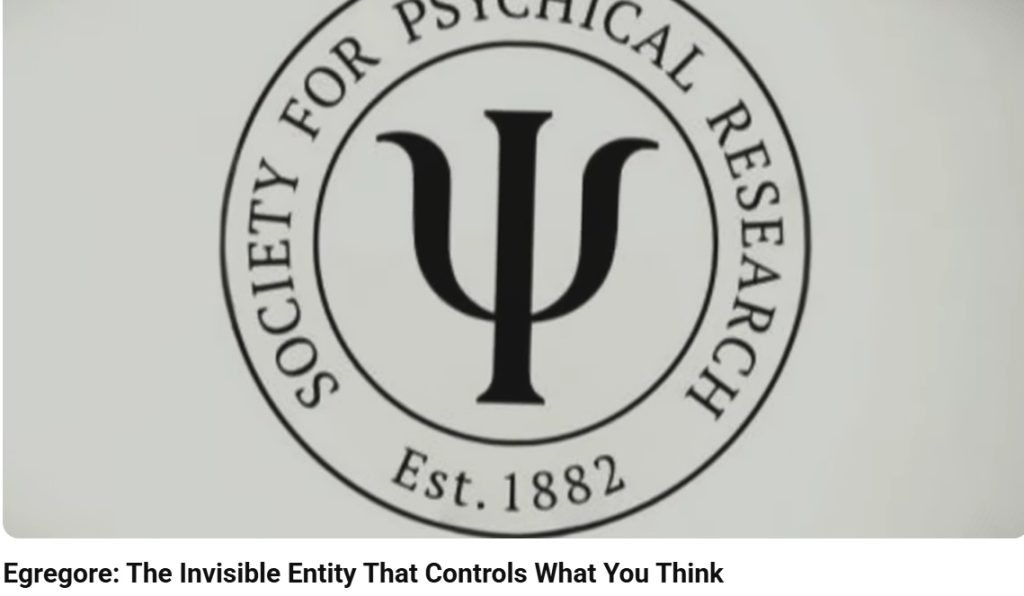
The Philip Experiment (1972) – Toronto Society for Psychical Research
Herbert Simon – Attention Economy concept (1971)
The Third Wave Experiment – Ron Jones (1967)
Robbers Cave Experiment – Muzafer Sherif (1954)
Gustave Le Bon – “The Crowd: A Study of the Popular Mind” (1895)
British East India Company historical records
Deindividuation research (psychology)
Tulpa concept (Tibetan Buddhism)
Transcript
Original video link: https://www.youtube.com/watch?v=i5zLbiM0c3o
In September 1972, the boundaries of human psychology were tested by the Toronto Society for Physical Research.
Led by the geneticist and mathematician Dr. ARG Owen, a group of eight intellectuals decided to attempt the impossible. They would not hunt a ghost. They would manufacture one.
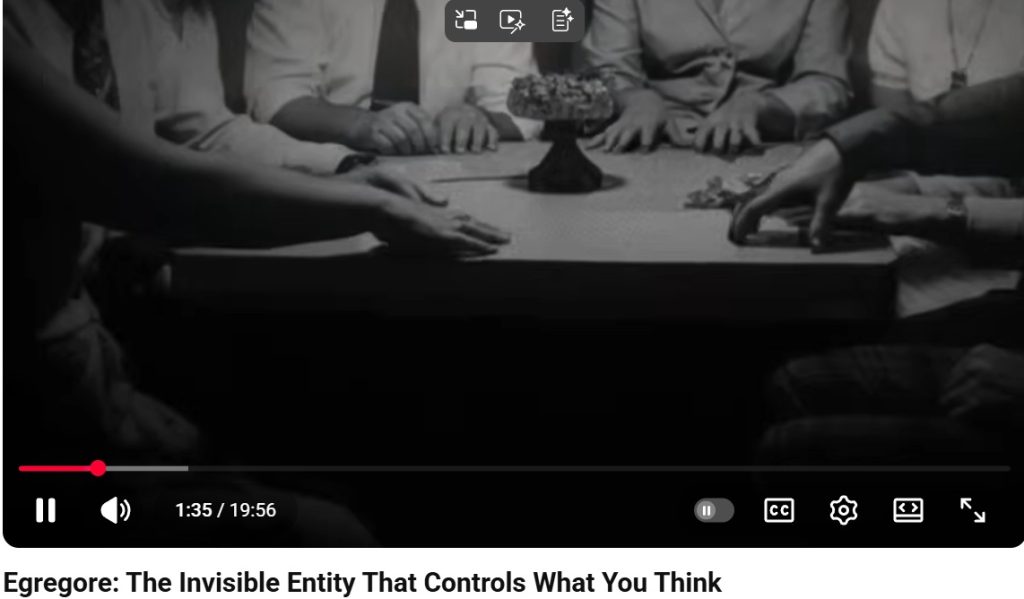
They sat around a generic card table in a lit room and invented a character from scratch.
They named him Philillip Alsford. They wrote a tragic detailed biography for him. A Catholic aristocrat in 17th century England married to a cold frigid woman named Doretha who eventually fell in love with a Romany girl.
According to their fiction, the affair led to scandal, the girl’s death at the stake and Philip’s eventual suicide in 1654.
They drew his portrait. They memorized his favorite foods, his political leanings, and his deepest regrets. They created a shared mental simulation so detailed it felt like a memory.
Then they dimmed the lights and called out to him. For weeks, the room remained dead. They sat in silence, feeling foolish, feeding their collective attention into the void.
But the group persisted, focusing their will on this fictional vessel. Then the impossible happened.
The table began to vibrate under their fingertips. Loud percussive traps reverberated from the wood. One for yes, two for no.
The entity began answering questions with a personality that matched the fiction. It could be petulent, funny, or somber. In front of cameras and independent observers, the
table will tilt on a single leg or slide across the room without human contact. It did more than just move. It reacted.
When the group told jokes, the table laughed by rocking back and forth. When they asked about his wife, the movements became violent.
The Philip experiment proved something terrifying about the nature of consciousness. Philip wasn’t a spirit of the dead. He was a psychic structure created by the focused belief of the living.
The Tibetans have a specific name for this phenomenon, Tulpa, a being forged through sheer mental discipline that eventually gains independence from its creator.
However, Western occulticism uses a different term, one that applies not just to seance rooms, but to nations, corporations, and ideologies.

They call it an egregor. An egregor is a group mind. It is an autonomous psychic entity that forms when a group of people focus their emotional energy on a shared symbol or idea.
It begins as a tool, a concept to unify a tribe. But as it gains energy, it takes on a life of its own.
It develops in an instinct for self-preservation. It begins to demand sacrifice. We tend to think of our thoughts as private fleeting electrical signals trapped in our skulls.
But the Philip experiment suggests that thoughts when synchronized gain mass. They gain agency. If eight people in a room can create a ghost that moves furniture, what kind of an entity is created by millions of people focusing on a rigid political ideology?
What kind of a phantom is summoned by a billion people worshiping a fiat currency? We assume we are the thinkers of our thoughts. But the history of mass movements points to a different direction.

Often we are merely the cells in a much larger body dreaming the dreams of a monster we built but can no longer control.
To understand how an agreor rules, you must first understand what it eats. Biological organisms require calories to function.
Psychic organisms require attention. Attention is the currency of consciousness. It is the raw energy that animates reality.
When you pay attention to something, you are literally paying it with your life force.

In 1971, at the dawn of the information age, the Nobel Prize-winning economist Herbert Simon coined the term attention economy.
He famously noted that in an informationrich world, the wealth of information means a darth of something else, a scarcity of whatever it is that information consumes.
What information consumes is the attention of its recipients.
He realized that in a world of overload the most valuable resource were not gold, oil or land. It was the focused awareness of the human being. An agreor is a metabolic engine that
converts human attention into structural power.
Let’s look at a modern sports team. On paper, it is a legal entity, a trademark, but it only comes alive in the stadium. When 50,000 people scream in unison, a palpable electric energy fills the air. The individual ego dissolves. The shy accountant becomes a screaming fanatic. The gentle school teacher becomes capable of violence against a stranger simply because they are wearing a different color jersey.
They have entered the belly of the agregoore . The entity feeds on the emotional release. The dopamine highs of witry the cortisol spikes of defeat.

It doesn’t matter to the agreor if the emotion is positive or negative. Just as it doesn’t matter to a fire what you throw into it. It only demands that it burns.
That is why the modern news cycle is engineered for outrage and not information. A political egregor cannot survive on compromise on nuance.
Compromise is low energy.
Nuance is calorically deficient. A calm nervous system does not click, share, or donate.
To sustain its existence, the collective thought form must provoke a freeze, fight or flight response in the nervous system of the host. It needs you terrified of the other. It needs you
obsessed with the latest existential crisis. It needs your adrenaline. When you are triggered, when your heart rate spikes over a headline, you are feeding the beast.

The exhaustion you feel after an hour of doom scrolling is a form of psychic predition. You have been harvested. We think of possession as an archaic superstition, something that
happens in horror movies involving demons and priests.
We fail to recognize the legal forms of possession we sign contracts with every day. The most powerful egregor in the modern world are not actually religious or cults. They are corporations.

In 1600, the British East India Company was granted a royal charter. In the eyes of the law, it became a body corporate, a legal fiction. It had the rights of a person but it had no soul, no conscience
and no physical body to jail.
Yet this invisible entity conquered the entire Indian subcontinent. At its height, the company commanded a private army of 260,000 men, twice the size of the British Empire’s own military.
It waged wars, levied taxes, and minted coin.
During the Bengal famine of 1770, while millions starved to death, the company actually increased tax collection to maintain its revenue streams.
It wasn’t that the men running it were necessarily monsters. It was that the entity they served had no biological capacity for empathy.
The men working for the company were fathers, brothers, churchgoers.
But when they clocked in, they became the hands of the Egregore. The company’s directive was profit. Any human morality that stood in the way of profit was metabolized and neutralized by the system.

This is the realworld definition of the paperclip maximizer. A thought experiment in AI safety where an artificial intelligence destroys the world just to fulfill its programming to make more paper clips.

The East India Company was a paperclip maximizer made of paper and bureaucracy.
Today we live under the thumb of algorithmic agrees. Social media platforms are entities programmed with a single survival instinct, time on site.
The algorithm quickly learned that the best way to keep you on the site to show what disturbs you.
It learned that conspiracy theories spread six times faster than the truth. It learned that vanity and insecurity keeps users trapped in a loop of comparison.



The algorithm is not a person. You cannot reason with it. It has no empathy. It is a digital agregor that has colonized the minds of billions of children, shaping their self-worth to fit its metabolic needs.
We ask why are people acting so crazy? The answer is that they are being piloted by systems that view human sanity as an inefficiency.
How does the collective mind override the individual?
The mechanism is known in psychology as deindividuation.
In 1895, the French sociologist Gustav Lebon wrote the crowd, a study of the popular mind. He observed that when a man joins a crowd, he descends several rungs in the ladder of civilization.
Lebon noted that the collective mind is intellectually inferior but emotionally amplified. In a group, the individual’s critical faculty, the part of the brain that says, “Wait, this is a bad idea,” is suppressed.
It is replaced by a sense of invincible power and anonymity. The responsibility for action is offloaded onto the group. I didn’t do it. The mind rationalizes. We did it. This is soft possession. It doesn’t require a ritual or a chant. It only requires a consensus reality. When you adopt an ideology, you’re accepting a prepackaged set of thoughts.

You don’t have to think about the economy. The ideology tells you what to think.
You don’t have to judge a person’s character. The ideology tells you if they’re good or bad based on the label they wear. This is efficient. It saves energy. The brain is biologically
wired to save energy, but the price is your soul.
The philosopher Simone Wei wrote, “The collective is the great beast.” She realized that the social animal is always a conformist. To belong is to be safe. To descent is to die.
This is an evolutionary truth hardwired into our amygdala.
The agregoore exploits this biological fear of exile. It says if you question the narrative, you will be cast out. You will be alone.
And so we silence our own intuition. We ignore the evidence of our own eyes to maintain our standing in the group. We engage in group think which is simply the internal dialogue of the agregor
spoken through human mouths.
When you speak, are you speaking or are you reciting a script written by a collective that doesn’t know your name?
History provides a terrifying laboratory of what happens when an egregor goes fully pathological.

In April 1967, a history teacher named Ron Jones wanted to teach his high school students in Palo Alto, California about how the German population could have blindly
followed the Nazi party.
The students couldn’t understand it. They said, “We would never do that. We think for ourselves.” So Jones started an experiment.
He called it the third wave.
On Monday, he introduced strict discipline. He made them sit at attention, feet flat on the floor. He drilled them on speed and efficiency. The students reported feeling a strange
rush of focus and purpose.
On Tuesday, he introduced a salute and a slogan. Strength through discipline, strength through community. The students loved it. They felt powerful. They felt united against the rest of the school.
On Wednesday, he issued membership cards. He told them that non-members were to be monitored. The psychological shift was immediate. Students began reporting on
their own friends for breaking the rules.
The class size exploded as students from other periods skipped their own classes to join the movement.
On Thursday, the violence began. Jones appointed three students as bodyguards.
Dissident were physically threatened. The library was purged of unauthorized books. Jones had lost control. The egregor had arrived.
In 5 days, a liberal California history teacher had turned a classroom of teenagers into a fascist youth group. Jones had to end the experiment on Friday by revealing it was a hoax.
He gathered them in an auditorium for a national announcement only to show them a blank screen followed by footage of the Nuremberg rallies.
Many students cried. The main reason was not just because they were tricked, but because they were grieving.
They had lost the feeling of belonging to the beast.
The third wave demonstrates that the evil of history is not a rare genetic defect found only in certain nations. It is a latent potential in the collective psyche.
The agregor offers a trade. Give me your individuality and I will give you purpose. Give me your conscience and I will give you permission to hate without guilt.
For a human being who feels small, powerless and isolated, that is a seductive offer.
It is the ultimate deal with the devil. The strongest walls of the agregor are built with bricks of us and them.
In 1954, the psychologist Muzafa Sharif created the famous robbers cave experiment. He took 22 young boys, all from similar backgrounds, all normal, healthy, middleclass kids, and
split them into two groups at a summer camp. The Eagles and the Rattlers.
For the first week, the groups didn’t know the other existed. They bonded, created flags, and established hierarchies. They formed their own tribal agreor. Then the researchers introduced the groups to
each other.
Almost immediately the psychological shift occurred. It started with name calling. Then the eagles burned the rattlers flag. The rattlers retaliated by raiding the eagle’s cabin, overturning beds, and stealing private
property.
The researchers had to intervene when the boys began collecting rocks, filling socks to use as weapons.
These were normal boys who days prior would have been best friends. But the label rattler or eagle had rewritten their reality. The egregor cannot exist without an enemy. It defines itself by
what it is not. I am righteous because they are wicked. I am smart because they are sheep. I am saved because they are damned. This binary thinking is the hallmark of possession.
If you find yourself unable to feel empathy for a specific group of people, if you find yourself cheering for their suffering or rationalizing their pain, you have been infected.
The mystic Judo Krishna Morti warned, “When you call yourself an Indian or a Muslim or a Christian or a European or anything else, you are being violent.
Do you see why? Because you are separating yourself from the rest of mankind.” The agreor creates a hallucination of separation.
It makes you believe that your survival depends on the destruction of the other.
It blinds you to the humanity of the person standing across from you, turning them into a caricature that justifies your aggression.
But the spiritual truth, the truth found in the Upanishads, in the sermon on the mount and the unified fields of quantum mechanics is that there is no other.
How do you fight a monster that is made of thought? You cannot fight it with force. If you fight an agreor, you generate conflict energy, which is exactly what it eats.
Resistance merely tightens the knot. The more you argue with the internet, the stronger the algorithm becomes. The more you hate your enemy, the more you resemble them. The only way to kill an agregor is to starve it.
You must withdraw your attention. This is not the same as ignorance or apathy. It is a deliberate act of spiritual hygiene. It is that Dowist practice of wooue
non-action applied to the machinery of mass hysteria.
In psychology, there is a technique for dealing with narcissists called the grey rock method.
You become as uninteresting and unresponsive as a gray rock. You deny the narcissist the emotional reaction they crave.
We must apply the gray rock method to the systems of control. It means witnessing the outrage without becoming outraged.
It means seeing the bait, the headline, the scandal, the fear, and choosing not to bite. It means recognizing that your attention is a holy resource, one that you have been squandering on phantoms.
The Gnostics believed that the world was patrolled by archons, parasitic entities that fed on human suffering and ignorance.
They taught that the path to liberation was not to conquer the archons but to transcend the level of reality where they exist to become transparent to the system.
When you return to the present moment, the agreor dissolves. The agreor needs time. It needs a past to resent and a future to fear.
It cannot exist in the now. In the now, there is no nation. There is no cooperation. There is no political party. There is only the breath.
There is only the sensation of the body against the chair. There is only the silent spacious awareness that contains it all.
That is why meditation is a revolutionary act. It is the reclaiming of the means of production.
But the production is your own consciousness.
When you sit in silence, you are cutting the supply line to the collective hallucination.
You are taking your energy back from the phantom philillip,
back from the cooperation, back from the war machine. You become a sovereign entity.
The silent war for the soul is a war of attention.
The systems of the world are designed to fracture your focus, to keep you looking outward, to keep you feeding the ghosts of history.
But the door to the cage is unlocked. It has always been unlocked. You simply have to stop looking at the shadows on the wall and turn around.